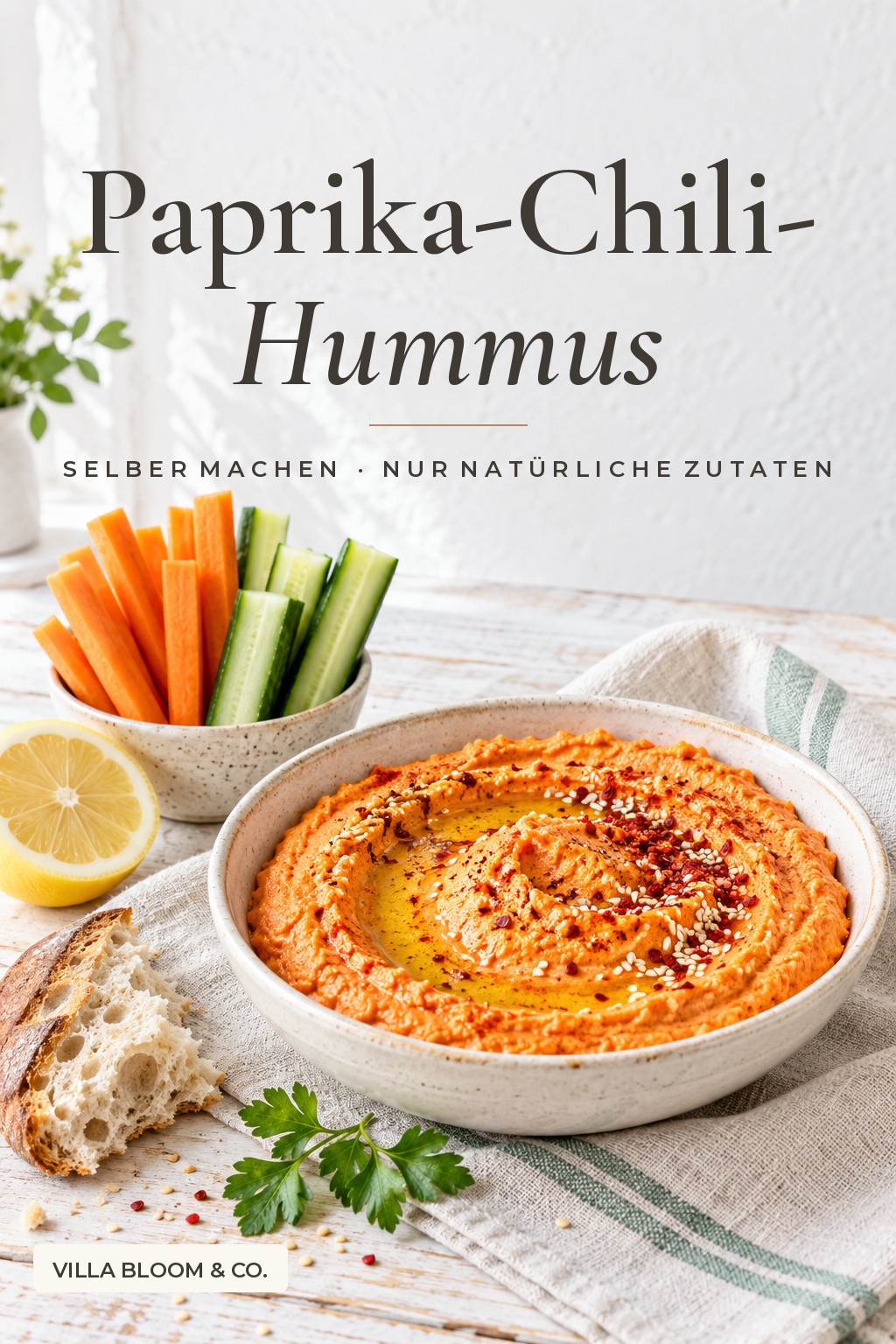
Roasted Pepper Chili Hummus – creamy, smoky, made with nothing but natural ingredients
A hummus that tastes like the one from the chiller cabinet – without the spirit vinegar, the sugar and the additives. Roasted peppers, smoked paprika, chili and good tahini, ideally all organic. Ten minutes of work, one hour of resting.

There are those small tubs in the chiller cabinet you pick up because they are so convenient: orange hummus, gently spicy, very creamy, a little smoky. The label lists chickpeas, sesame, peppers, chili, smoked paprika, garlic – and somewhere in between, spirit vinegar, sugar and an oil that most likely is not cold-pressed. None of that is bad. But none of it is necessary.
Exactly this hummus can be rebuilt at home in a few minutes, from ingredients you can name one by one and that are all available on the organic shelf. The difference lies not in a secret ingredient but in three small things: roasted peppers instead of raw, enough tahini and oil for creaminess – and patience, because hummus only comes into its own in the fridge.
Why home-made hummus tastes different
A supermarket hummus has to keep for weeks. That is why it is stabilised with acid, usually spirit vinegar, and rounded off with sugar so the acid does not show. Both do their job, both change the taste: the vinegar makes the paste slightly sharp, the sugar smooths it in a direction that recalls a ready-made sauce rather than chickpeas.
At home none of that is needed. The hummus is eaten within a few days, so the acid can come from freshly squeezed lemon – milder, fragrant, and a better match for sesame and peppers. The sweetness comes from the roasted pepper itself; if you like, add half a teaspoon of honey, no more. And because the oil is no longer just a carrier, it can be a good one: a cold-pressed rapeseed oil with a mild nutty note or, for a slightly more Mediterranean touch, a gentle olive oil.
What remains is a hummus with exactly the colour and texture of the shop-bought one, but tasting of what is actually in it.

The ingredients – and what matters with each one
Chickpeas. One can of organic chickpeas, about 240 g drained, is enough for a generous bowl. If you cook your own, take about 100 g dried, soak them overnight and cook them very soft – happily a quarter of an hour longer than necessary, because the softer the chickpeas, the creamier the paste. Canned works just as well; the only thing that matters is rinsing them thoroughly.
Tahini. The sesame paste is the heart of a hummus, not a side note. 40 to 45 g for one can of chickpeas looks like a lot but is exactly the point where chickpea purée turns into hummus. Organic tahini from hulled, light sesame is milder and less bitter than the one from unhulled seeds; for this recipe the light kind is the better choice. Stir well before measuring, the oil settles in the jar.
Roasted peppers. The real trick for colour and creaminess. Raw pepper makes the hummus watery and grassy; roasted pepper brings sweetness, depth and that warm orange tone. The easiest route is roasted peppers from a jar – the organic kind usually sits in nothing but water, salt and a little citric acid – drained well. If the oven is on anyway, place a halved red pepper skin side up under the grill until the skin blisters black, cover for ten minutes and peel. For this recipe you need half a large pepper.
Oil. Two to three tablespoons. Cold-pressed organic rapeseed oil stays in the background and lets pepper and sesame lead. A mild olive oil works too; a strong, grassy one, however, throws the hummus off balance.
Lemon. One and a half tablespoons of freshly squeezed juice, roughly half a lemon. It replaces the vinegar entirely and is the reason the home-made version tastes fresher.
Garlic. One small clove, no more. Raw garlic keeps building in the fridge; what seems subtle at first is clearly there after a night.
Spices. A teaspoon of sweet paprika for colour, half a teaspoon of smoked paprika for the smoky note, half a teaspoon of ground cumin as the base, plus chili flakes to taste – a quarter teaspoon for gentle warmth, half a teaspoon for noticeable heat. All of them come in organic quality; with smoked paprika it is worth reading the label, because it should consist of paprika only, not paprika plus smoke flavouring.
Salt, pepper and a hint of sweetness. About three quarters of a teaspoon of salt, a little black pepper from the mill. Half a teaspoon of honey or maple syrup is optional and balances the lemon – with very sweet, ripe peppers it can be left out altogether.
The recipe
Roasted Pepper Chili Hummus
10 minutes of work · 1 hour of resting
Ingredients for about 300 to 350 g
- 1 can organic chickpeas (about 240 g drained) or 100 g dried, cooked very soft
- 40–45 g light organic tahini
- ½ large red pepper, roasted (from a jar or home-roasted), well drained
- 2–3 tbsp cold-pressed organic rapeseed oil or mild olive oil
- 2–4 tbsp cold water
- 1½ tbsp freshly squeezed lemon juice
- 1 small garlic clove
- 1 tsp sweet paprika
- ½ tsp smoked paprika
- ½ tsp ground cumin
- ¼–½ tsp chili flakes
- ¾ tsp salt
- black pepper from the mill
- optional ½ tsp honey or maple syrup
- Prepare the chickpeas. Tip the chickpeas into a sieve, rinse thoroughly under cold water and drain. For an especially smooth result, simmer them in fresh water for another ten minutes – then they blend almost without any graininess.
- Blend everything except the oil. Put chickpeas, tahini, drained pepper, garlic, lemon juice, all the spices, salt and, to begin with, two tablespoons of cold water into a blender or a tall beaker for a stick blender. Blend for at least two minutes, scraping down the sides now and then. The mixture should be completely smooth before the oil goes in.
- Stream in the oil. With the blender running, add the oil slowly in a thin stream and blend vigorously once more. Only now does the hummus get its silky sheen.
- Adjust the texture. If the paste is too firm, add cold water a tablespoon at a time, blending briefly each time. Straight from the blender it may be a touch softer than you want – it firms up in the fridge.
- Let it rest. Transfer to a bowl or a clean jar and chill for at least an hour. This is when smoked paprika, garlic and lemon really come together.
- Season – but only now. Taste after resting. Usually a pinch of salt is still missing, sometimes a squeeze of lemon or a little chili. Anyone who seasons straight after blending almost always overdoes it.
Tip: The hummus looks best spread into a shallow bowl with the back of a spoon, leaving a well in the middle. A little oil into the well, then smoked paprika, a few chili flakes, toasted sesame seeds and, if you have them, a few leaves of flat-leaf parsley. A strip of roasted pepper on top shows what is inside.

Three variations worth trying
Mild family hummus. Leave out the chili entirely and add half a teaspoon more sweet paprika instead. The pepper carries the colour, the smoke stays, the heat is gone – children happily eat it with vegetable sticks.
Autumn pumpkin and pepper hummus. Replace half the chickpeas with 120 g of soft-baked Hokkaido pumpkin. The hummus becomes even creamier and slightly sweet; raise the cumin to a full teaspoon so it does not turn too tame.
Extra smoky for the grill. Instead of the jarred pepper, roast a whole red pepper directly on the grill or over a gas flame until the skin is black all over. The smoky note becomes much stronger, and the smoked paprika can be reduced to a quarter teaspoon.
What to serve it with
As a dip for carrot, cucumber and kohlrabi sticks it is the obvious choice, but it can do more. On toasted sourdough with tomatoes and a little salt it becomes a quick supper. In a bowl with roasted vegetables, lentils and a spoonful of yoghurt it takes the role of the sauce. As a spread in a wrap with rocket and grilled courgette it holds everything together. And with autumn roasted vegetables – pumpkin, beetroot, parsnips – it is almost better as a dip than any herb quark, because smoke and chili work against the sweetness of the vegetables.
If you are putting together a small buffet, set it next to a classic hummus and a green one with herbs: three colours, the same basic technique three times, one evening sorted. More ideas for that are in the autumn party food collection.

Keeping and batch-cooking
In a clean, sealed jar the hummus keeps in the fridge for three to four days. A thin layer of oil on top protects the surface from drying out and discolouring. Freezing works in principle – best in small jars with room at the top – but the texture becomes a little grainier after thawing and needs a quick stir with a spoonful of water or oil.
If you make hummus regularly, cook chickpeas in a larger batch and freeze them in 250 g portions. It is cheaper than cans, saves packaging and gives the creamiest paste, because you decide the cooking time yourself.
Frequently asked questions
- Can I make this hummus without tahini?
- You can, but it becomes more of a roasted pepper and chickpea dip. Tahini gives the typical nutty depth and creaminess. If sesame is a problem, two tablespoons of cashew or sunflower seed butter work as a substitute – it tastes different, but it works.
- Why is my hummus grainy?
- Usually the chickpeas are too firm or the blending too short. Simmer canned chickpeas for another ten minutes and blend for at least two minutes before adding the oil. A high-speed blender gets there faster than a stick blender, but with patience both will do.
- Can I use raw pepper?
- Raw pepper makes the hummus watery and grassy. The characteristic colour and sweetness only come from roasted pepper – from a jar or roasted yourself.
- How spicy is it?
- With a quarter teaspoon of chili flakes it is pleasantly warm, with half a teaspoon clearly spicy. The heat builds a little in the fridge, so start cautiously and adjust after resting.
- Can I use vinegar instead of lemon?
- Yes, with a tablespoon of mild organic cider vinegar. Lemon juice is the fresher and more harmonious choice for this recipe, though.
- Is this hummus vegan?
- With maple syrup instead of honey, or with no sweetener at all: yes. All other ingredients are plant-based anyway.
Read on
If you are making this hummus for an evening with guests, the autumn party food collection has the finger food to go around it. The German edition of this recipe is at Paprika-Chili-Hummus selber machen.