Plum and Oat Tray Bake with No Added Sugar – juicy, tart, with a crunchy top
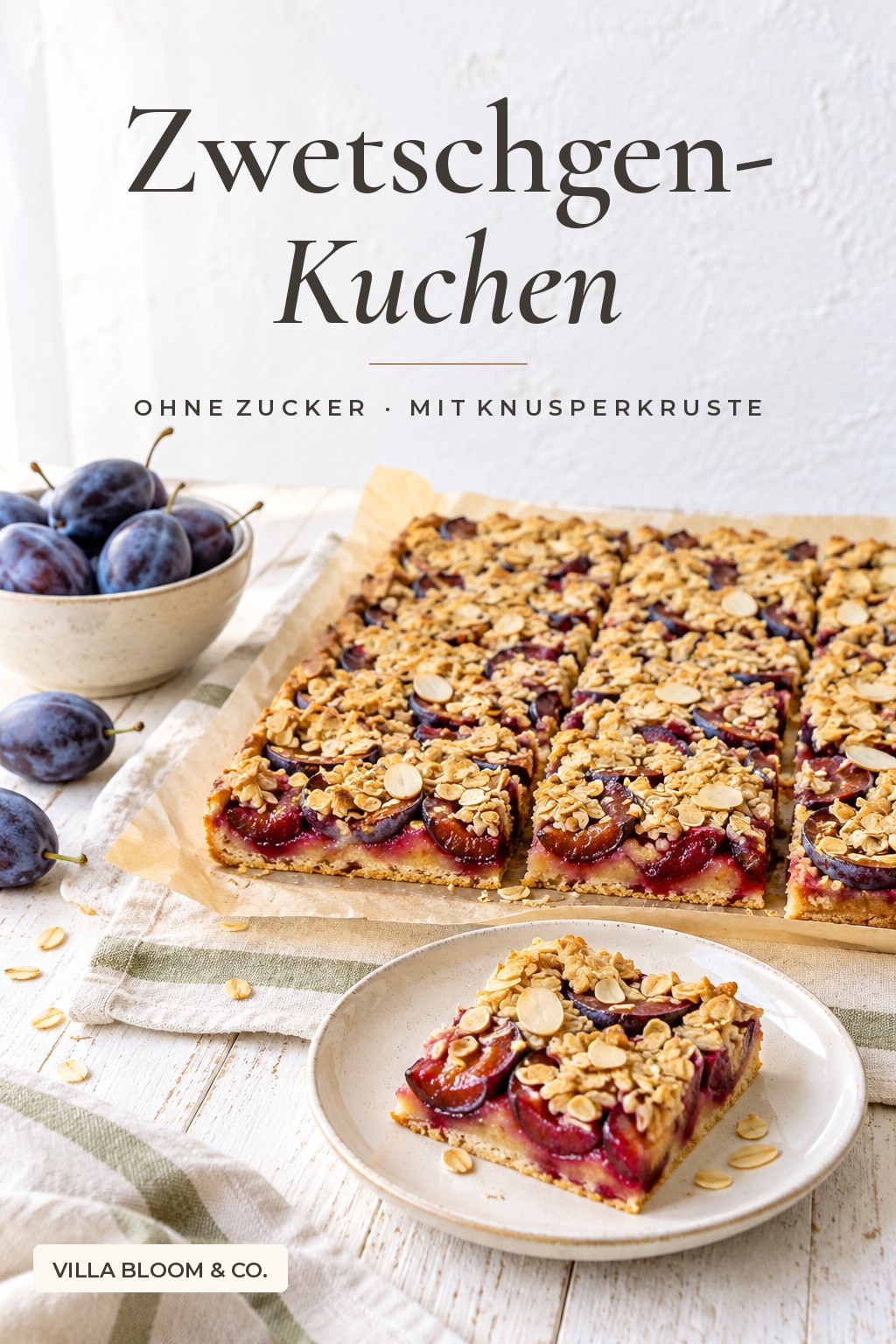
The cake for the few short weeks when there are plums: halved fruit packed close together on a soft oat batter, under a crunchy layer of oats and almonds – sweetened with nothing but dates and fruit. No sugar, no syrup, no sweetener. And proof that a plum cake without sugar need not be sour.

Plum cake is one of the few cakes almost everyone shares a memory of: a tray, a yeast or shortcrust base, plums cut side up, plenty of sugar over the top so the acidity does not come through. That sugar is exactly the point. Plums are more acidic than apples and pears, and anyone baking them without sugar has to catch the acidity another way – not cover it, but embed it.
This cake does that with three things: with a few more dates than the other cakes in the series, with a grated apple in the batter that brings sweetness and juice, and with a crunchy layer of rolled oats, ground almonds and cinnamon that browns lightly in the oven and wraps the tart fruit in something warm and nutty. What comes out is a tray bake with dark red rims of juice, a soft crumb and a lid that crackles when you cut it – and that tastes of plums, not of sugar with plums.
It is the third sweet part of the Naturally Sweet series, after the apple walnut cake and the pear and oat tray bake it grew out of as a variation – and the first to get a crust of its own.
Damsons, prune plums or round plums – and why it matters
This recipe is written for the small, oval, dark blue European prune plum – the German Zwetschge, close to the English damson or Italian prune plum: firm, yellow-green flesh, a stone that comes away cleanly. Round dessert plums are juicier, often sweeter, and their stone clings to the flesh. For a tray bake the prune plum is the better choice: it keeps its shape in the oven, gives off less water and has exactly the acidity that makes this cake interesting. Round plums work too; then the cake turns out softer and sweeter, and the baking time goes up by five minutes because more juice has to evaporate.
The season is short: prune plums come in from late August to early October, early varieties from the end of July. They are ripe when they give slightly but are still firm, and when a fine white bloom shows near the stem – not a flaw, but a sign the fruit has not been washed and rubbed. For the cake they should lean slightly underripe rather than overripe; overripe fruit collapses on the tray.
What "no sugar" means here
As with every cake in the series: no added sugar, no syrup, no sweetener. The sweetness comes from 150 g of dates, one grated apple and from the plums themselves, which become noticeably sweeter in the oven than they are raw. So fruit sugar is in there, as in every cake with fruit. What this cake shows particularly well is that acidity and sweetness belong together. A plum cake that tightens a little on the first bite and then turns warm and nutty is exactly right – and most people who try it reach for a second piece, because it does not fill you up the way a sweet cake does.

The ingredients one by one
Plums. 500 g, which is 25 to 30 prune plums depending on size. Halve, stone, do not cut further – halved plums cut side up keep their shape and release their juice downwards into the batter instead of losing it on the surface. Pack them close; they shrink in the oven.
Dates. 150 g of soft, pitted dates, soaked and blended smooth with the water. That is 30 g more than in the pear cake, because the plums are more acidic. With very ripe, sweet fruit you can go down to 130 g.
One apple in the batter. Coarsely grated, juice and all. It brings sweetness and moisture and keeps the batter under the juicy plums from becoming too dense. A sweet variety like Gala or Elstar is right here – the plums already supply the acidity.
Oats and almonds. 120 g of fine rolled oats for the batter, 80 g of them ground, 40 g whole. Plus 60 g of ground almonds, which make the batter more tender and a little paler than in the pear cake – almond and plum is a pairing that has existed for centuries for a reason.
The crunchy layer. 60 g of fine rolled oats, 40 g of flaked almonds, a teaspoon of cinnamon, a pinch of salt, two tablespoons of rapeseed oil and two tablespoons of the date purée, set aside beforehand. Rub everything together with your fingers until it crumbles. This layer replaces the streusel a classic plum cake would have – without butter, without sugar, and it still turns crunchy because the date purée caramelises lightly in the oven.
Yoghurt, eggs, oil. 150 g of plain yoghurt for the tender crumb and the acidity that keeps the cake fresh. Three eggs for binding and structure. 80 ml of cold-pressed rapeseed oil – no more is needed, because apple, yoghurt and plums bring plenty of moisture.
Spices. One and a half teaspoons of cinnamon in the batter, plus a quarter teaspoon of ground cloves and a quarter teaspoon of cardamom – clove and plum is the classic autumn pairing, but it has to stay sparing or the cake tastes of mulled wine. The zest of half an unwaxed lemon, half a teaspoon of salt.
The recipe
Plum and Oat Tray Bake with a crunchy top
25 minutes of work · 40–45 minutes in the oven · 20 × 30 cm tin
Ingredients for a small tray or tin of 20 × 30 cm (about 12 pieces)
- 150 g soft organic dates, pitted
- 120 ml hot water
- 500 g prune plums (or damsons), halved and stoned
- 1 sweet apple (e.g. Gala or Elstar)
- 120 g fine rolled oats (80 g ground, 40 g whole)
- 60 g ground almonds
- 120 g wholemeal spelt flour
- 2 tsp baking powder
- ½ tsp bicarbonate of soda
- 1½ tsp cinnamon, ¼ tsp ground cloves, ¼ tsp ground cardamom
- zest of ½ unwaxed lemon
- ½ tsp salt
- 3 medium eggs
- 150 g plain whole-milk yoghurt
- 80 ml mild, cold-pressed organic rapeseed oil
- For the crunchy layer: 60 g fine rolled oats, 40 g flaked almonds, 1 tsp cinnamon, 1 pinch salt, 2 tbsp rapeseed oil, 2 tbsp date purée (taken from the batter)
- baking paper, a little oil for the sides
- Soak the dates. Roughly chop the dates, pour over the hot water and leave for ten minutes. Preheat the oven to 180 °C (conventional), line the tin with baking paper and lightly oil the sides.
- Prepare the plums. Wash, halve, stone. Lay them on a cloth so they do not go onto the batter wet.
- Blend the date purée, set two spoonfuls aside. Blend the dates with their soaking water until very smooth. Set two tablespoons aside for the crunchy layer.
- Mix the crunchy layer. Rub oats, flaked almonds, cinnamon, salt, oil and the two spoonfuls of date purée together with your fingers until small crumbs form. Chill.
- Dry ingredients. Grind 80 g of the oats coarsely and mix with the whole oats, almonds, flour, baking powder, bicarbonate, spices, lemon zest and salt.
- Wet ingredients. Add yoghurt, eggs and oil to the remaining date purée and whisk smooth. Peel the apple, grate coarsely and stir in with its juice.
- Bring the batter together. Add the dry mixture to the wet and fold in briefly. Leave for five minutes so the oats can swell. The batter is thick and flows slowly.
- Top. Spoon the batter into the tin and level it. Arrange the plum halves cut side up, close together in rows, and press in lightly. Scatter the crunchy mixture evenly over the top; the fruit may show through.
- Bake. 40–45 minutes, until the crunchy layer is golden, the plums are soft and dark red juice bubbles at the edges. Test with a skewer between the fruit – it should come out clean.
- Cool. Rest in the tin for at least 30 minutes so the juice can soak into the batter. Then lift out by the baking paper and cut into twelve pieces.
Tip: Plum cake without sugar is clearly better on the second day than the first. Overnight the juice settles through, the acidity rounds off, the dates come forward. If you bake it for guests, bake it the day before – and warm the pieces briefly in the oven so the crust is crunchy again.

Two variations
With poppy seed. Two tablespoons of ground blue poppy seed in the batter and one in the crunchy layer – poppy seed and plum are a fixed pair in Bohemian and Austrian baking, and the faintly bitter note of the poppy suits the fruit acidity well. The cake turns out darker, earthier, a little more festive.
As a plum and almond cake without oats. For anyone who does not like oats: replace the 120 g of oats in the batter with 80 g of ground almonds and 40 g of spelt flour, and make the crunchy layer from flaked almonds, cinnamon, oil and date purée only. The cake becomes finer and more tender, but keeps for three days rather than five, because the oats that bind the moisture are missing.
What to serve it with
Lukewarm with a spoonful of unsweetened yoghurt or skyr it is a dessert that looks like more than it costs. With black tea or coffee in the afternoon it needs nothing else. Cold at breakfast, with a few fresh plums beside it, it works like the pear cake – a little more tart, but with a crust. And if you bake a tray for guests in September, set a bowl of unsweetened whipped cream next to it; the sweetness comes from the cake, the cream only brings the roundness.

Keeping and freezing
Covered in the fridge the cake keeps for four to five days. The crunchy layer softens over the days – warmed briefly in the oven or toaster, it comes back. At room temperature two days at most, because of the yoghurt and the fruit juice. It freezes well, in pieces with baking paper between them, for up to three months; the plums stay surprisingly firm on thawing. Once thawed, best given ten minutes at 160 °C in the oven, and it is like fresh.
To stretch the plum season, freeze the halved, stoned fruit raw – flat on a tray, then into bags. They go onto the batter straight from the freezer, and the baking time goes up by five minutes. That way this cake lasts into winter.
Frequently asked questions
- Does the cake turn out too sour without sugar?
- No – provided three things are right: ripe plums, the full 150 g of dates and the crunchy layer that embeds the acidity. If you prefer it milder, add a second grated apple to the batter or let the plums sit with a spoonful of date purée for ten minutes before topping.
- Why does so much juice run out?
- Plums release juice in the oven; that is normal and welcome – it soaks into the batter as the cake cools. Too much juice comes from overripe fruit or from fruit that goes onto the batter wet. Dry well after washing and keep the full 30 minutes of resting time.
- Can I use round dessert plums?
- Yes, with five minutes more baking time. They are sweeter and juicier; then 130 g of dates is enough, and the fruit should go onto the batter in quarters rather than halves so it does not release too much water.
- Does the crunchy layer really turn crunchy without butter and sugar?
- Yes, thanks to the rapeseed oil and the date purée, which caramelises lightly in the oven. It does not become as hard as classic butter streusel, more like a granola lid. For extra crunch, add it only after 15 minutes of baking.
- Can the cake be made vegan?
- Yes, with plant yoghurt and three tablespoons of ground flaxseed in nine tablespoons of water in place of the eggs. Extend the baking time by five minutes. The crumb becomes a little denser, the crust stays the same.
- Can I leave out the cloves and cardamom?
- Both are optional. With cinnamon alone the cake tastes more clearly of plum, with cloves warmer and more autumnal. For children, better without cloves.
Read on
All recipes in the series are on the Naturally Sweet page. The pear and oat tray bake is the milder sibling of this cake, the apple walnut cake the rounder one. The German edition of this recipe is at Zwetschgen-Hafer-Kuchen ohne Zucker.