Style · Spring 2026
My sense of home in little style notes
For me, style is not a list of furniture or brands. It’s a few principles I hold to – quiet ones, but very clear. Here I share what those principles are, and show you how they feel in everyday life: on a shelf, at a table, throughout a whole home. Not rules, more like notes from my own attempt to live beautifully.
Post №1 · Style foundations
The 7 pillars of my style
what Villa Bloom & Co. stands for
People often ask me how I would describe my style – and honestly, for a long time I didn’t have a proper answer. Until I started making notes of what I do again and again and what I consistently don’t do. Out of that grew seven pillars – the ones that carry my whole sense of home.
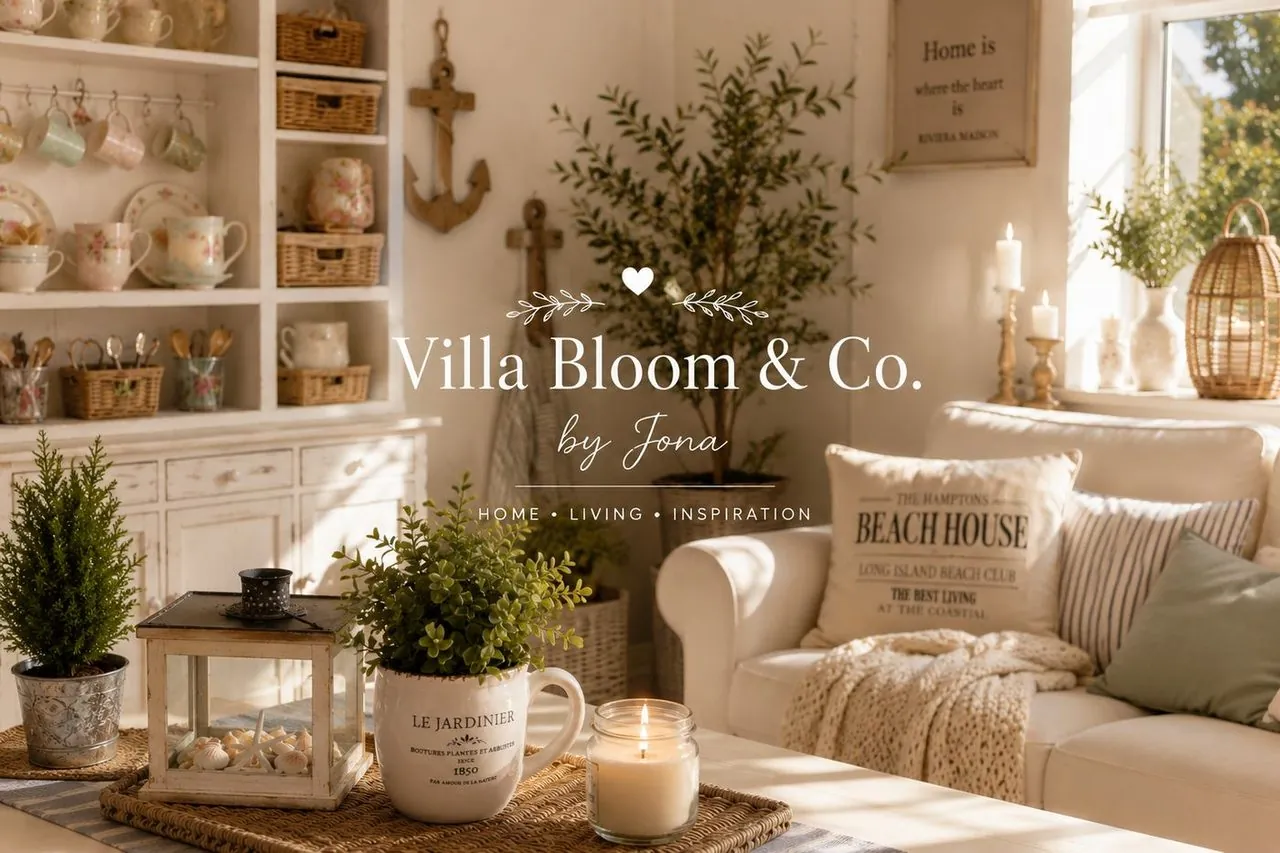
Style foundations · the seven pillars of my sense of home
I believe everyone who wants to live beautifully should at some point find their own style pillars. Not to show off or to post – but because then every buying decision becomes easier. A piece either fits my style or it doesn’t. That saves money, space and, above all, that bad feeling when a piece of furniture already seems somehow “wrong” after three weeks. Here are my seven.
The seven pillars
-
Creamy instead of stark white. I’ve banished pure white from my home. Everything in my rooms has a warm cream tone that reflects the light softly instead of throwing it back coldly. Even grey days feel instantly more homely that way. My favourite trick: a hint of ochre in the wall colour – it lifts the whole mood by three degrees.
-
Sage instead of mint. My green is always muted, slightly dusty, like an olive leaf in late summer. Fresh mint green has no place in a real country house – that’s ice-cream-parlour territory. Sage, eucalyptus, salbei: those are my tones. They reconcile with cream and with wood, which mint never manages.
-
Vintage instead of glossy-new. At least a third of every room was not bought new. Inherited, picked up at the flea market, dug out of an old barn. These pieces have history – and you can feel it. An inherited chest of drawers is always lovelier than the same model from the furniture store, because it has already been used.
-
Fabric instead of plastic. Real textiles everywhere: linen, cotton, wool. The tea towel is fabric, not microfibre. The basket bag is woven, not made of plastic. The tablecloth is woven too. This isn’t eco-fanaticism – it’s simply lovelier, feels better and ages more gracefully.
-
One real plant per room. At least one that I have to water – something that grows and changes. Plastic plants aren’t allowed in my home. They take the soul out of a room. I’m allowed to forget a leaf now and then – that’s part of it. Living rooms have living plants.
-
Pattern mixing in moderation. Stripes, florals, gingham – I love to combine them, but never on the same scale. A large floral plus thin stripes plus tiny dots works wonderfully. Three patterns of the same size side by side is chaos. My rule of thumb: at most three patterns per room, at least one of them “tiny”.
-
One centrepiece per room. Every room has a star. In the living room, the big, soft sofa. In the kitchen, the mint SMEG. In the bedroom, the bed with the floral headboard. Everything else is a supporting act and falls into line. If you have three stars in one room, they fight each other – and no one wins.
Little exercises to discover your own pillars
- Exploration tip · If you’re looking for your own style, don’t start at the furniture store. Walk through your house and make three lists: what do you still love? What annoys you? What was a gift that never really fit? The answers tell you more than any Pinterest board
- Colour test · Hold three fabric swatches side by side – if you ask “does that work?”, it doesn’t. If you immediately think “of course that works”, then it’s right. Trust your first gut feeling
- Vintage rule of thumb · At least a third of every room should be older than you are. That grounds a room and gives it depth – without you being able to explain it right away
- Basic pattern rule · At most 3 patterns per room. At least 1 of them “small” (tiny dots, thin stripes, little flowers). Never all 3 in the same size – that’s the most common pattern-mixing trap
- Plant hierarchy · One large, one medium, one small per field of view. Odd numbers always look more relaxed and natural than even ones. The same goes for vases, candles, picture frames
- Less is more · If you’re not sure whether something is still missing: wait a week. If you still think so then, something really is missing. Most of the time, though, it’s just your eye that still needs to get used to it
“Style is not a list of furniture but a list of principles – seven are enough for a whole lifetime.”
These seven pillars aren’t set in stone. They developed over years, some were added, some fell away again. But today they give me a compass: when I stand in front of a piece of furniture, I test it against the pillars. Does it fit? Then it may move in. Doesn’t it fit – even if it’s beautiful – then it stays in the shop. This clarity feels good. Perhaps it will help you find your own pillars.
More from StylePost №2 · Style tutorial
Shelf styling, country-house style
from overstuffed to magazine cover
The open shelf in the country kitchen – or in the living room – is my favourite style tool of all. It’s an open stage for everything you love. But that’s exactly what makes it tricky: too full, too empty, too uniform – and it doesn’t work. With a few simple tricks, any overstuffed shelf turns into a real magazine vignette.
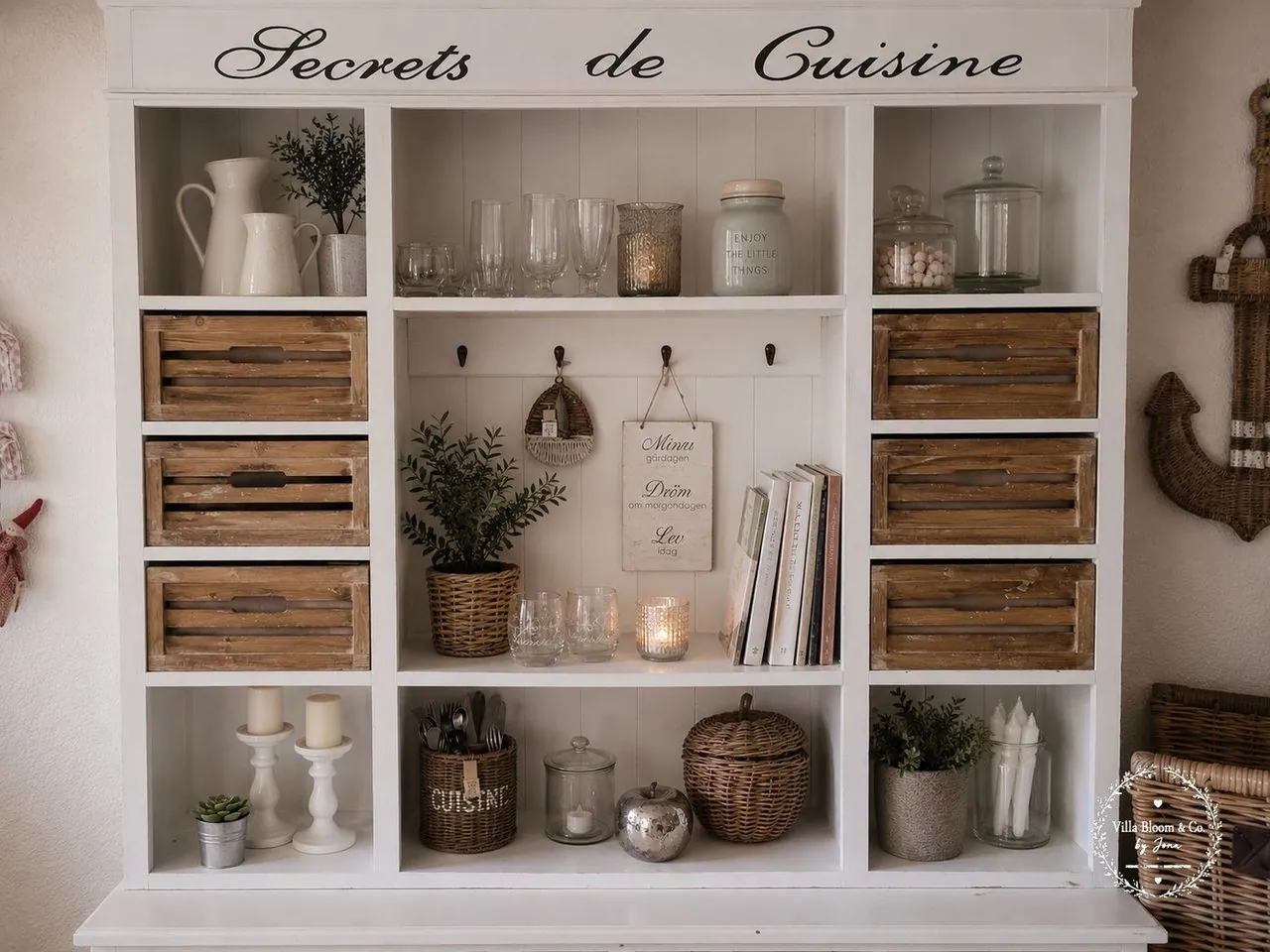
From chaos to magazine cover · styling an open shelf properly
Beautiful shelves never look accidental – even if they’re meant to look loose and “organic”. Behind every beautiful open shelf there are, in truth, a few simple tricks about heights, groupings and breathing space. Once you’ve internalised them, you see them everywhere – and you can completely transform your own shelf in 30 minutes.
What you need
Your materials from your own home
- 1open shelf (3–5 compartments are ideal)
- 4–6different cups or bowls
- 2–3glass jars or storage tins (for pasta, flour, muesli)
- 2–3books (cookbooks, novels, old editions with beautiful spines)
- 1–2small plants or bunches of flowers in a glass
- 1–2decorative highlights (candle, framed picture, wooden bowl)
- 1small blanket or a tea towel to drape
- 30 minof quiet and a little urge to play
How to go about it
-
Everything out. Take really everything off the shelf. Including what you haven’t even looked at. Wipe the boards clean. This isn’t optional – you need the completely empty stage to be able to think anew. If you start “shifting things around”, it all ends up like before.
-
Sort into three piles. Cups and crockery in one pile, storage jars in the second, books and decor in the third. Whatever you no longer love or haven’t used in ages goes away or into another room. Be brutally honest here – this is the most important step.
-
Understand the three-height rule. In every compartment you need three different heights: tall (an upright jug, vase, book on end), medium (cup, glass, small bowl), low (flat dish, stacked books, board). If all the objects are the same height, it becomes visually flat and boring.
-
Start with the large pieces. Place the largest items first – books stacked flat, a large jug, a tall storage jar. They are the anchors and determine the composition. Only after that do the smaller objects come into play.
-
Think in groups of three. Three cups with a similar look. Three storage jars with different kinds of pasta. Three books with matching spine tones. Odd numbers always look more harmonious than even ones – I don’t know why, but it’s true. Trust it.
-
Let it breathe! This is the most important rule: don’t fill every compartment. At least a third of every compartment may simply stay empty. These empty spots are the whole secret – they instantly turn “overstuffed” into “curated”. Without them, nothing works.
-
Work in a piece of fabric. A folded tea towel under a vase, a small blanket loosely draped through the shelf, a linen napkin under a wooden board. Fabric breaks up the hard geometry of glass and ceramic – and makes the whole thing homely instead of sterile.
-
Three steps back. Now look at it from two metres away. Is any compartment too dense? Too empty? Does your gaze tip to one side? Swap two things. Step back again. Repeat until the overall view feels right – even if you can’t explain why.
So your shelf stays beautiful in the long run
- Weekly reset · Once a week, dust the shelf and swap 1–2 things while you’re at it. That keeps it alive instead of frozen – and you prevent chaos from quietly creeping back in
- Seasonal change · A complete restyle every 3 months. Tulips in the vase in spring, rosehips and acorns in autumn, a fir branch with little lights in winter. The shelf then tells the season too
- Book trick · Group book spines by colour. Vintage editions or uniform bindings instantly look more refined than a colourful mix. The truly hardcore even wrap books in brown paper – Pinterest goes wild for that
- Storage jars · Colourful kinds of pasta in identical jars look like an Italian deli. Lentils, beans, rice – all in clear glass with a cork lid. Costs almost nothing, looks like 1000 euros
- No frills · A plastic key dish, a wooden “Welcome” sign from the discount store, three fridge magnets – that’s not styling, that’s clutter. Get rid of it. The room breathes a sigh of relief at once
- Dare to leave gaps · The most beautiful shelves have air between the objects. If you think “something should go there” – usually not. Leave it empty. That’s exactly where elegance is born
“An open shelf is a stage – and stages need air between the actors.”
Once you’ve internalised these tricks, your eye never switches off again. You’ll see badly styled shelves everywhere – in the café, in films, at friends’ houses – and immediately know what’s missing. That’s the reward for 30 minutes of work on your own shelf: a trained eye that accompanies you through your home for all your other styling too. I promise, this will become your new favourite style trick.
More from StylePost №3 · Seasonal style
Spring table decor
one set of basics, styled three ways
My favourite proof of style: you do NOT need different crockery for every occasion. With a good basic set and a few additions from the garden and the drawer, you turn the same plates into a completely different world three times over. Here I show how a plain cream dinner set becomes a brunch, an apéro and a Sunday meal.
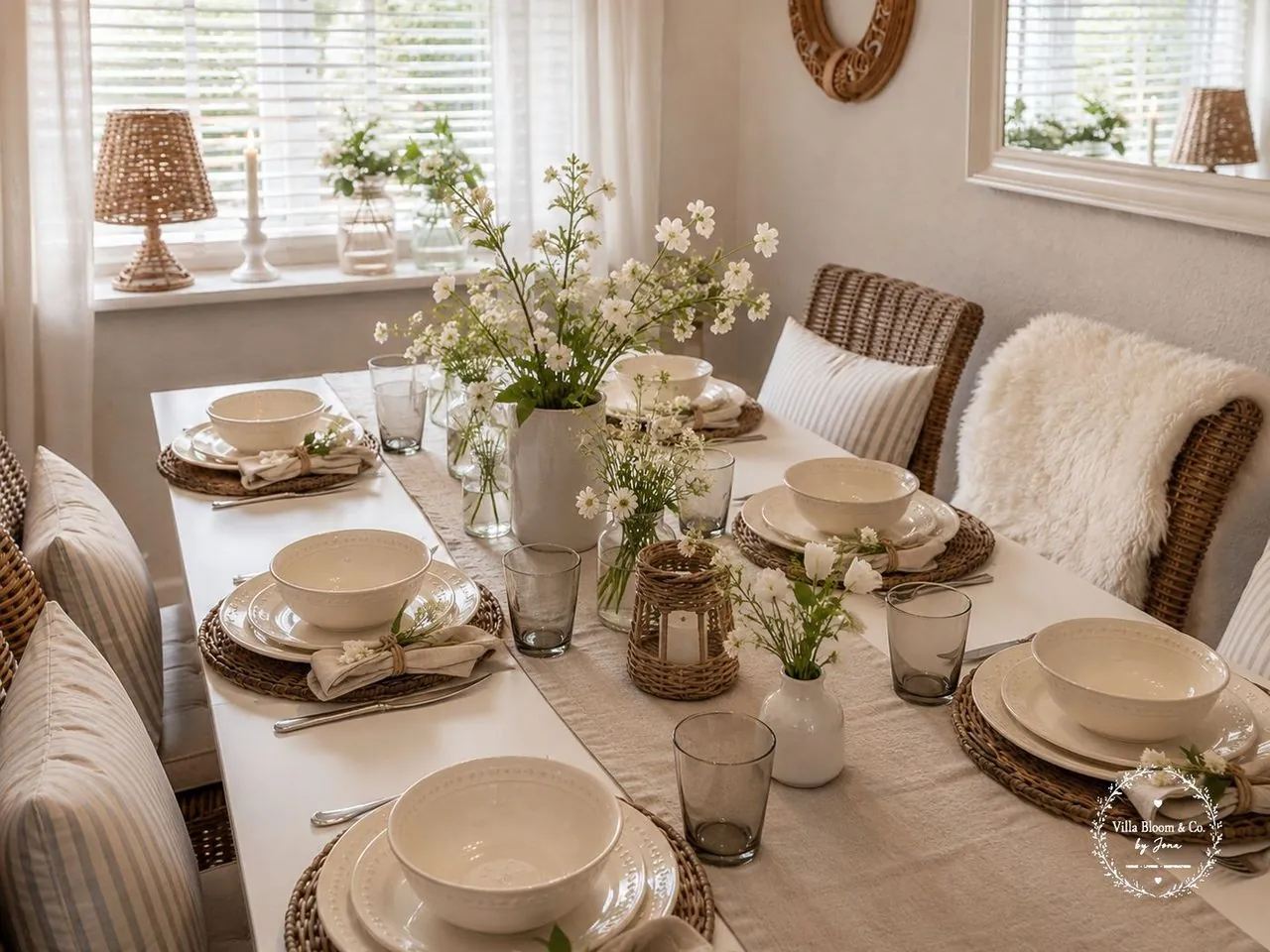
One dinner set, three worlds · spring table decor in May
Better to invest once in a really good neutral basic dinner set than to buy a new seasonal set twice a year. With a few fabrics, a few wildflowers and an idea, you transform the same table into completely different moods. That’s not only more stylish but also more sustainable – and far more fun, because it’s about composition, not consumption.
The basics
The neutral foundation for all three looks
- 4–6large cream-coloured plates (matte, not glossy)
- 4–6small plates or little bowls
- 4–6plain water glasses (pressed glass or thin glass)
- 1 setof linen napkins in natural white
- 1 setof plain cutlery (matte silver or wooden handles)
- 1neutral table runner in linen or cotton
Three looks in detail
-
Look 1 · May brunch. Sunday morning, the sun falls through the window, the mood is loose and easy-going. What you add: a wooden board with cheese and jam, small glass jugs with milk and elderflower cordial, a slim vase with daisies in the middle. Colour accent: natural white and a hint of soft yellow from butter and honey. Serving trick: everything in the middle of the table – brunch thrives on everyone helping themselves. Alongside it, my rhubarb streusel cake slices or strawberry tart from the recipes.
-
Look 2 · afternoon aperitivo. Late afternoon at 5 pm, the sun turns golden, dinner is still two hours away. What you add: small olive dishes, a serving board with cheese and a few wild garlic pesto crackers, slim champagne flutes or small tumblers, an elderflower Hugo in a carafe. Colour accent: sage and sandy beige, a touch cooler than the brunch. Serving trick: small and elegant – nibbles instead of a main meal. Fold the napkins small, never fill the glass to the brim. Aperitivo thrives on understatement.
-
Look 3 · Sunday meal with the family. A late-afternoon meal, everyone at the table, dusk slowly falling outside. What you add: fabric napkins in gingham pink or fine stripes, a longer fabric runner, two taper candles in slim glass holders, a wildflower bouquet in white and soft lilac in a pretty carafe, plus a separate water carafe. Colour accent: warm natural tones with a dab of gingham pink. Serving trick: the bread wrapped in a fabric napkin in the middle of the table – that makes it cosily Italian. Perfect main course: the asparagus quiche from the recipes, with a green salad.
The rules that apply to every look
- Three-height rule · At the table too: tall elements (candle, vase), medium ones (plate, glass), low ones (flat dish, board). If everything sits at the same height, it becomes visually flat – no matter how beautiful the individual pieces are
- The odd number · 3 vases are always better than 2 or 4. 5 candles are better than 4 or 6. With plates too: 3 kinds of cheese on the board, not 2. The odd number simply looks more harmonious – a law of nature
- Flowers from the garden · Wildflowers, herb stems, an olive branch look far more charming than supermarket bouquets. Whatever you find in the garden or by the wayside is always right – even a single tulip stem in a tall vase
- Folding napkins · No fuss. Folded once lengthwise, loosely draped on the plate or beside the cutlery. The elaborate swan folds are nothing for a relaxed table culture
- Candle rule · Low during the day (tealights, small pillar candles), higher in the evening (taper candles). But: table candles must ALWAYS stay below the eye level of those seated. Otherwise you look through flames instead of into faces
- Feel the season · In May, small blossoms belong on the table, in summer herb sprigs, in autumn acorns and berries, in winter fir branches and candles. Let the garden or the forest inspire you – costs nothing and looks authentic
“Beautiful crockery thrives on being used – not on being spared.”
That’s the beautiful thing about a good basic dinner set: it grows old with you, goes with you through the seasons, through different homes, through life. While a “spring set” is no longer fashionable after three years, you can still style cream plates beautifully in 20 years – they just change their accompaniments. Invest in the foundation, play with what surrounds it. That’s not only more stylish but also far more relaxed. And whoever sets the table in a relaxed way is more up for having guests afterwards.
More from Style